


Outdoor Sectional or Sofa and Chairs for Your Patio
Choose an outdoor sectional when a continuous seating arrangement fits the way your household lounges and gathers. Choose a sofa with separate chairs when independent seating positions and a more adjustable conversation layout are more important. The better option depends on your usable space, daily activities, and access routes.
Compare both approaches on the same patio plan before choosing a style. A sectional can make a clear seating zone, while separate chairs can change where people face. Neither arrangement automatically provides more useful seating or uses less space in every home.
Begin with the way you spend time outside
Think about a normal week rather than a single large party. Do you usually share a sofa, sit opposite a partner, or host guests who prefer their own seat? Do you read, talk over drinks, or move regularly between the lounge area and another part of the patio?
A household that enjoys sitting together may appreciate a continuous run of seating. People who prefer face-to-face conversation may find a sofa and two chairs easier to arrange. These preferences should lead the choice before you compare photographs of coordinated collections.
Also consider whether the layout needs to change. If a patio regularly serves several activities, independent pieces may offer useful placement options. Actual flexibility depends on the size and weight of the furniture and the room available to move it, so confirm those details for the products you shortlist.
Compare useful seats rather than package labels
The number of pieces in a set includes more than seating. A four-piece package may contain a sofa, two chairs, and a table. A sectional package may include several seating modules and a table, with a corner that people use differently from the end positions.
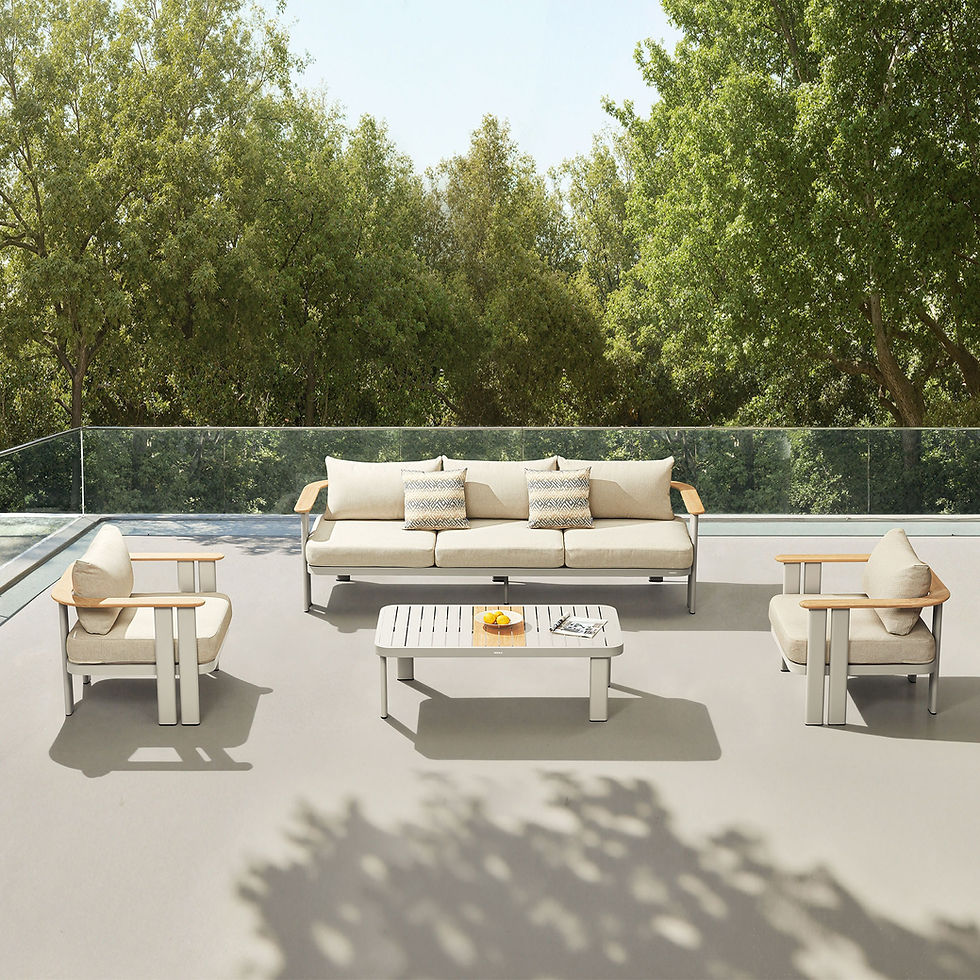
HIGOLD's Denea product page lists two single sofas, one three-seat sofa, and a coffee table. This is a clear example of a sofa-and-chairs arrangement. It allows the two independent seats to be considered separately when planning the group.
For a sectional, look at each occupied position and its access. Ask whether the corner is comfortable for the way guests sit and whether the end seats offer the arm support you want. Compare these practical positions with the independent chairs rather than assuming the same capacity label creates an identical experience.

Draw both arrangements at the same scale
Mark doors, steps, fixed features, and the main walking route first. Draw the complete product footprints, including the tables. With separate chairs, show the angles at which they will actually stand rather than placing every piece in a tight rectangle to make it fit.
For the sectional, use the manufacturer's assembled configuration diagram. Individual module dimensions are useful, but they need to be interpreted in the correct orientation. Do not simply add every listed width and assume it represents the final arrangement.
Try both plans with tape on the ground. For the sofa-and-chairs version, use temporary seats to test how people enter and face one another. For the sectional version, mark the return and the corner clearly. Keep the same table-use expectations for both comparisons so one option does not appear better merely because a needed surface was omitted.
Consider personal space during conversation
Separate chairs create distinct seats. That can be useful when guests prefer an armrest or their own orientation. Check that the chairs can face the sofa without putting their backs directly in the main route.
A sectional creates adjacent positions along a continuous form. It can suit shared lounging, but several adults may use its corner differently from the way a household does when relaxing alone. Test with the people who will use the furniture most often.
Avoid choosing from seat count alone if personal space is important. One person may be happy sitting close beside a family member, while a guest may prefer a separate chair. Your patio can support that preference without requiring every seat to match exactly in shape.
Think about rearranging and daily maintenance
If you expect to move the furniture, check the actual product weights and the instructions for handling connected modules. A modular sectional may require specific disconnection steps. Separate chairs may be easier to reposition in your space, but size and weight still matter.
Count the cushions you would need to move or store under the manufacturer's recommended care routine. Consider where they will go and whether that location is convenient. The two arrangements may have similar seating capacity but different cushion shapes and storage demands.
If future replacement matters, ask how the seller identifies individual cushions and components. Keep the model and configuration details. Do not assume that matching items will always remain available or that pieces from a later collection will connect to an earlier one.
A simple decision for a shared patio
Imagine a patio used for quiet evenings and occasional meals outdoors. The household wants a lounge area but must preserve the route to a dining table. A sectional that projects into that route may be less practical than a sofa with a chair on each side. On a different patio, the sectional could fit along two edges and leave the route completely open.
The decision comes from the occupied plan. Test reaching the table, walking behind or beside seats, and getting up from the corner. A plan that works only when the chairs are tucked away or the sectional is empty does not represent normal use.
If both options fit, return to sitting preferences. Choose the arrangement that supports the activities you repeat most often, with occasional entertaining treated as a secondary requirement.
Compare configurations before committing to a collection
Shortlist one sectional and one sofa-and-chairs set that meet your actual needs. Compare package contents, usable seating, layout, and ownership requirements. Then choose materials and appearance within that practical shortlist.
Explore HIGOLD conversation sets, including the Denea sofa-and-chairs configuration. Use complete dimensions and current package details to make the comparison on your own patio plan.
The HIGOLD sectional models shown are design examples. Contact HIGOLD to confirm current model availability and the exact configuration; view the outdoor conversation set collection for current options.


Comments